SIL rostering software: shared supports, sleepovers, and roster-of-care review
A practical SIL rostering guide for NDIS providers reviewing shared supports, sleepovers, roster-of-care context, service agreements, and finance boundaries.
5
review points to connect before a SIL roster moves downstream
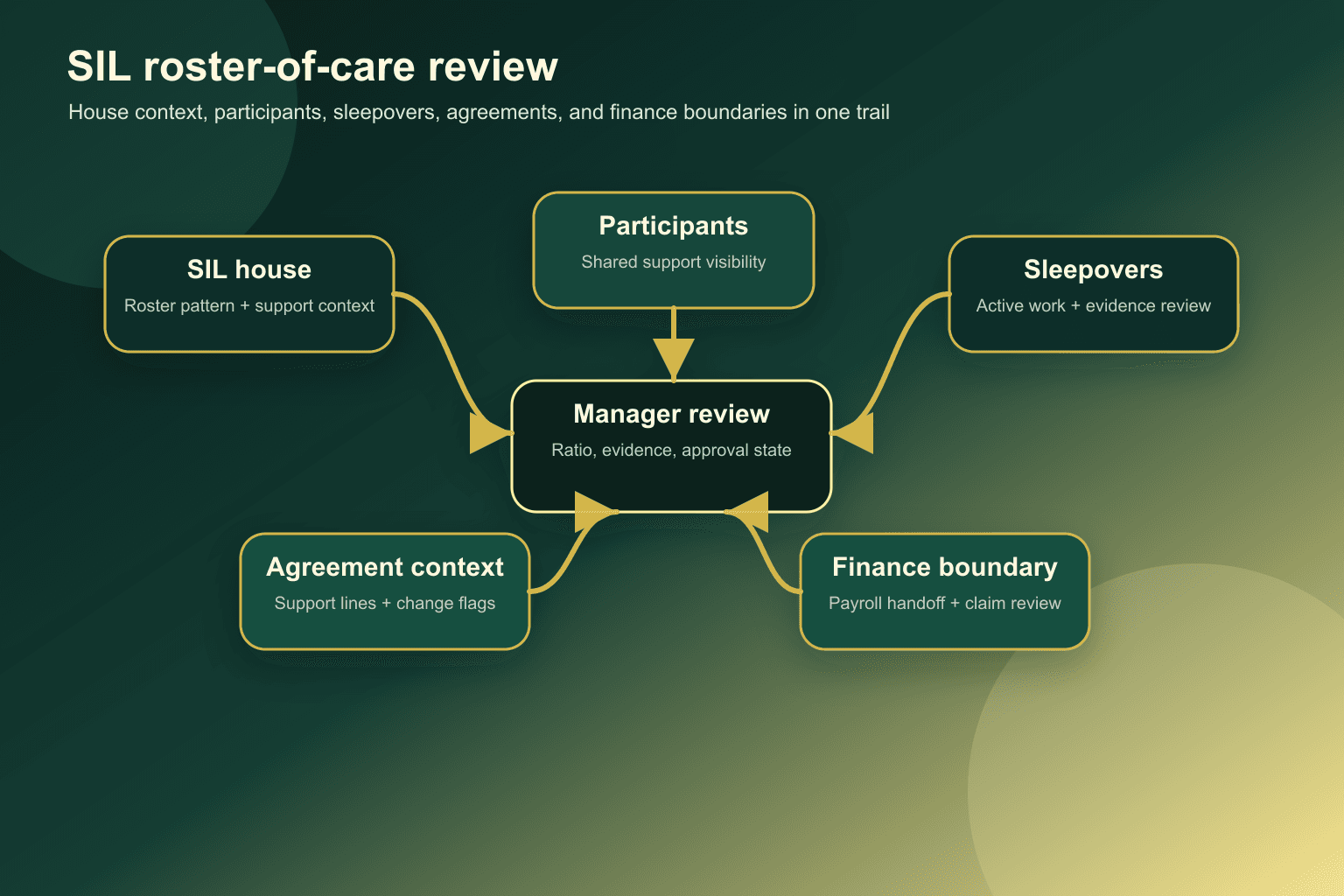
SIL providers need a roster-of-care trail.
The search intent is bigger than a shift calendar
When providers search for SIL rostering software, they are usually not asking for a prettier calendar. They are asking whether house rosters, participant supports, shared ratios, sleepovers, worker evidence, service agreement context, and finance review can stay connected in one operating trail.
The NDIS explains supported independent living as personal support for people with higher support needs who need help at home all the time. That makes the roster a live operating record, not just a staffing plan. Source: NDIS supported independent living overview.
Effica's SIL rostering software page is the right product path for this question because it sits between rostering, service agreements, sleepover review, participant funding context, and claim readiness.
The roster should explain who the support relates to.
Shared supports need ratio context, not a hidden note
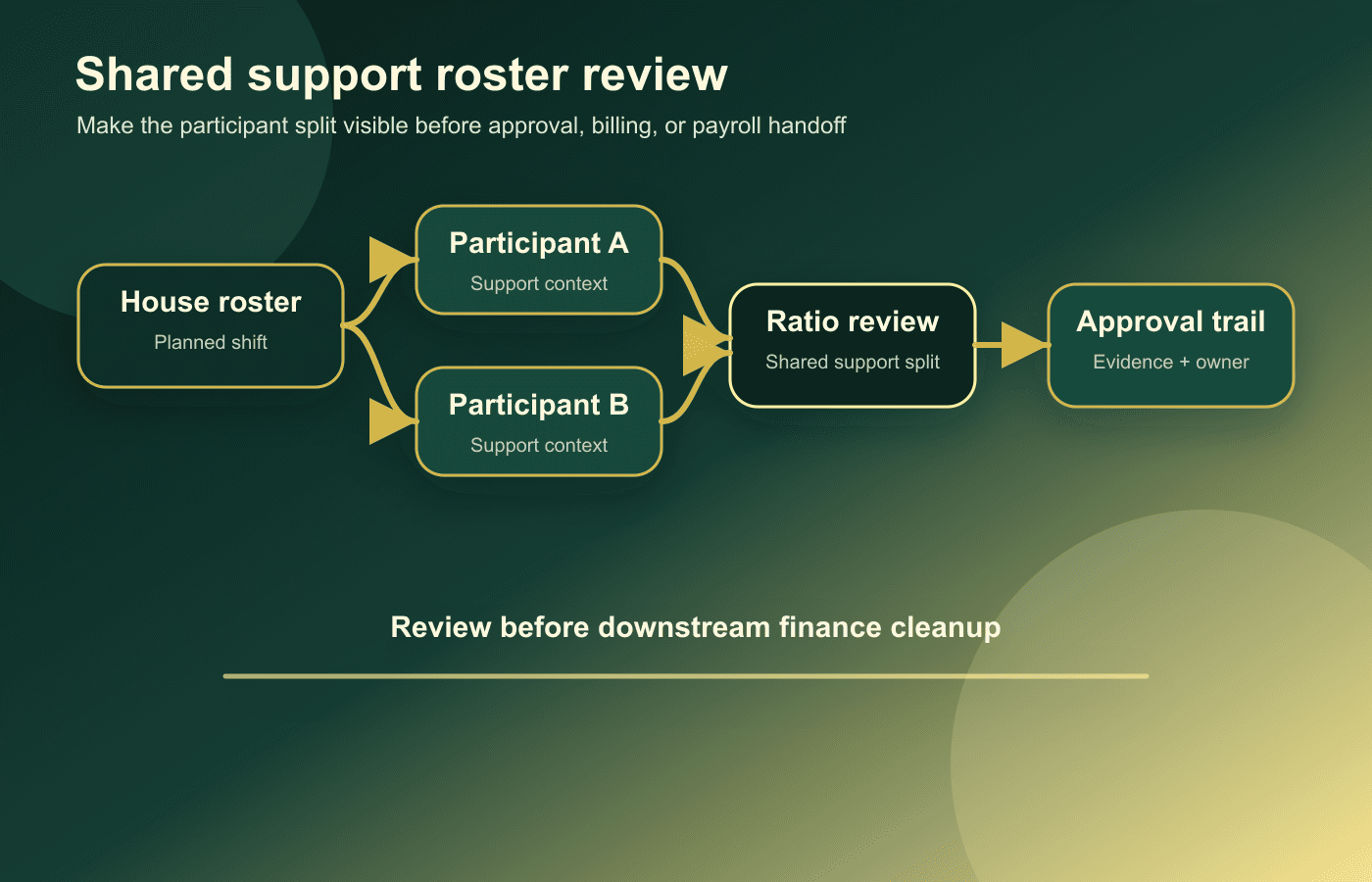
A shared support shift can look simple on a calendar while still carrying several operational questions: which participants are included, what support line or agreement context applies, what worker ratio was planned, what actually happened, and what needs review before billing or payroll moves.
The NDIS provider guide to SIL describes SIL providers helping participants with day-to-day activities in the home. For software, the practical takeaway is that house context and participant context both need to be visible when the roster is approved. Source: NDIS guide to providing SIL.
A useful roster review should make the shared-support split explicit enough for managers to see whether the planned support, worker evidence, service agreement context, and downstream finance review are aligned. It should not ask finance to reconstruct that story later from notes.
NDIS rostering software
Review the broader Effica rostering page for shift evidence, approval, payroll handoff, and claim readiness.
NDIS guide to providing SIL
Official NDIS provider guide for supported independent living.
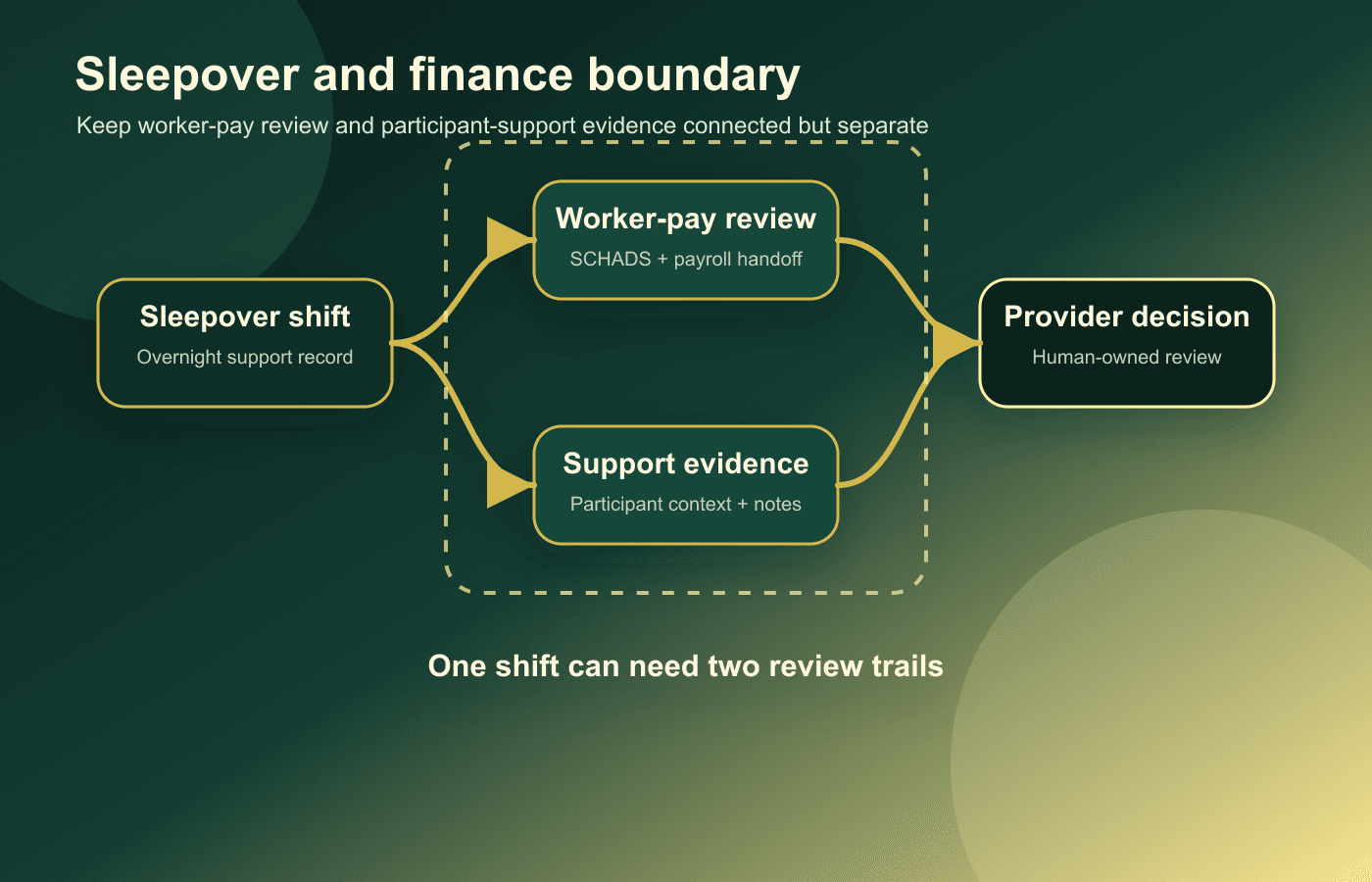
One overnight shift can create two different review trails.
Sleepovers need worker-pay and participant-support boundaries
Sleepovers create a common SIL software trap: payroll interpretation and participant support evidence can be treated as the same question. They are connected, but they are not identical. A provider still needs to review worker pay, active work, support evidence, participant context, and claim readiness separately.
The NDIS Commission explains that a sleepover shift is a continuous overnight span where a worker is required to sleep at a participant's premises. Fair Work guidance also says SCHADS sleepover changes took effect from an employee's first full pay period starting on or after 1 June 2026. Sources: NDIS Commission sleepover shifts and Fair Work sleepover changes.
Effica should surface that boundary rather than pretend to make legal, payroll, or claiming decisions. The product job is to keep reviewed evidence, support context, and handoff state visible so the provider can make the right decision with the right source material.
SCHADS sleepover changes article
Continue into the related source-backed article on sleepovers, mobile evidence, payroll review, and claims boundaries.
Fair Work SCHADS sleepover changes
Official Fair Work guidance on SCHADS sleepover changes.
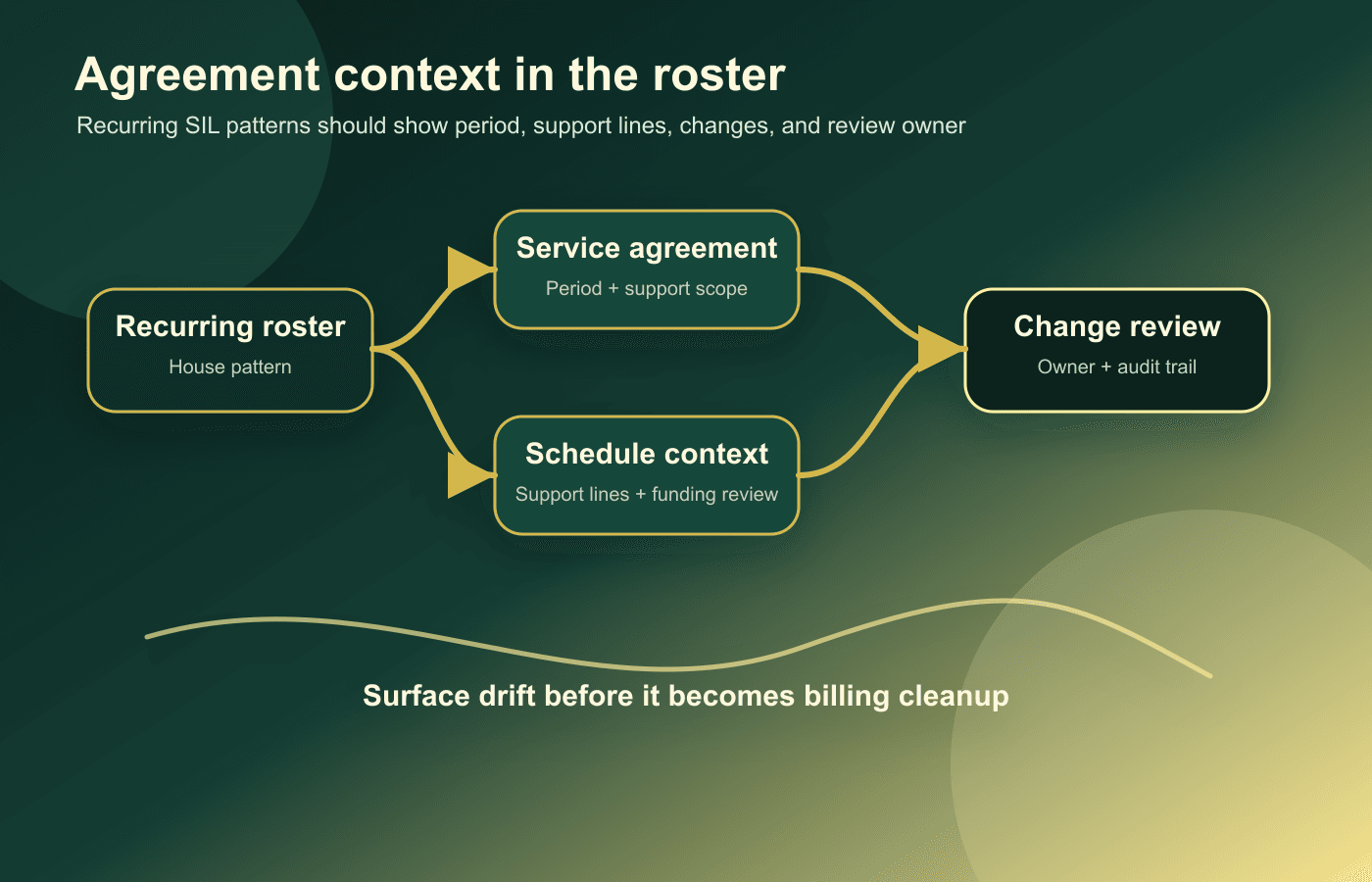
A roster pattern can drift when agreement context is separate.
Service agreements should travel with recurring roster work
SIL rosters are often recurring, which is exactly why agreement context matters. If participant needs, house arrangements, support lines, funding management, or review owners change, the recurring roster pattern should make that drift visible before it becomes billing cleanup.
The NDIS describes a service agreement as a signed agreement covering how supports are delivered, what they are, how much they cost, how the provider gets paid, and how changes are made. A SIL roster should keep that context close enough for review. Source: NDIS service agreement guidance.
That does not mean every roster user needs to read the full agreement on every shift. It means the software should expose the current period, support context, change flags, and review owner when a roster pattern depends on those records.
NDIS service agreement software
Review Effica's service agreement and Schedule of Supports workflow for roster and billing context.
NDIS service agreement guidance
Official NDIS explanation of service agreements.
The useful test is reviewability.
What to look for in SIL rostering software
A SIL roster tool should handle more than shifts and staff names. Look for house context, participant-level support visibility, shared-support ratio review, sleepover and active-overnight flags, service agreement context, mobile evidence, approval history, payroll handoff state, claim-readiness review, and clear audit trails.
Fair Work record-keeping guidance reinforces the need for accurate employment records and pay slips. For providers, that sits alongside NDIS evidence and participant support records rather than replacing them. Source: Fair Work record-keeping and pay slips.
Effica is being built around that connected review model. If your current SIL workflow depends on spreadsheet rosters, house notes, payroll exports, and separate finance cleanup, the next step is to review the SIL roster workflow against how your team actually approves support.
The practical SIL software question is whether each rostered support can explain the house, participant, ratio, sleepover, agreement context, evidence, approval state, and finance boundary before it moves downstream.
Continue with Effica
If your SIL roster-of-care, sleepover review, shared supports, and finance handoff still live across spreadsheets and notes, review the Effica SIL workflow.
Review the SIL roster workflowRelated Effica pages
SIL rostering software
Review the Effica product page for shared supports, sleepovers, service agreement context, and SIL roster review.
View pageNDIS rostering software
See the broader roster, timesheet, payroll handoff, and claim-readiness workflow.
View pageNDIS service agreement software
Keep Schedule of Supports and agreement context close to roster, billing, and renewal workflows.
View pageSCHADS sleepover changes
Read the related article on sleepovers, worker pay, mobile evidence, and claim boundaries.
View pageNDIS billing software
Continue into claim preparation, rejected lines, Xero reconciliation, and finance audit trails.
View pageContinue reading
More from the Effica blog
Software buying and migration
NDIS provider software buying checklist: data access, export and migration readiness
What Australian NDIS providers should test before choosing software: complete exports, connected attachments and history, a bounded migration rehearsal, and a practical exit path.
Read articleAudit readiness and evidence
NDIS audit readiness software: internal audits, evidence mapping and corrective actions
How NDIS providers can turn internal audits into owned work, connect quality indicators with live operational evidence, and follow corrective actions through to re-check.
Read articleProgress notes and review
NDIS progress notes software: mobile capture, manager review, record keeping and AI privacy
How NDIS providers can capture case notes on mobile, connect delivered supports with participant goals, review records promptly, and set safe boundaries for AI assistance.
Read article